
Introduction
Production Line Efficiency
In today’s highly competitive manufacturing environment, improving production line efficiency is no longer an option—it is a necessity. Manufacturers are under constant pressure to increase output, maintain consistent product quality, reduce operating costs, and deliver products faster while dealing with rising labor, energy, and maintenance expenses.
A production line that operates below its potential can create a chain reaction of problems. Small delays can quickly become production bottlenecks, equipment failures can lead to unexpected downtime, and inefficient material handling can slow down the entire manufacturing process.
For this reason, modern factories are continuously looking for ways to optimize their production lines, improve equipment performance, automate repetitive processes, and create a more reliable production environment.
The good news is that improving production line efficiency does not always require replacing an entire production system. In many cases, significant improvements can be achieved by identifying operational bottlenecks, upgrading critical equipment, improving maintenance strategies, optimizing material handling, and implementing targeted automation solutions.
In this article, we explore 10 proven strategies to improve production line efficiency and explain how manufacturers can create faster, more reliable, and more productive operations.
What Is Production Line Efficiency?
Production line efficiency refers to how effectively a manufacturing facility uses its available resources—including machinery, labor, materials, energy, and time—to achieve its production goals.
An efficient production line is capable of producing the required output while minimizing:
- Production downtime
- Material waste
- Equipment failures
- Unnecessary labor
- Energy consumption
- Production delays
- Quality issues
Production line efficiency is not simply about producing more products. It is about achieving the best possible output with the resources available while maintaining product quality and operational safety.
Several key performance indicators can be used to measure production efficiency, including:
- Overall Equipment Effectiveness (OEE)
- Production throughput
- Cycle time
- Downtime
- Defect rate
- Changeover time
- Equipment availability
Monitoring these indicators helps manufacturers identify areas that require improvement and make informed decisions about production line optimization.
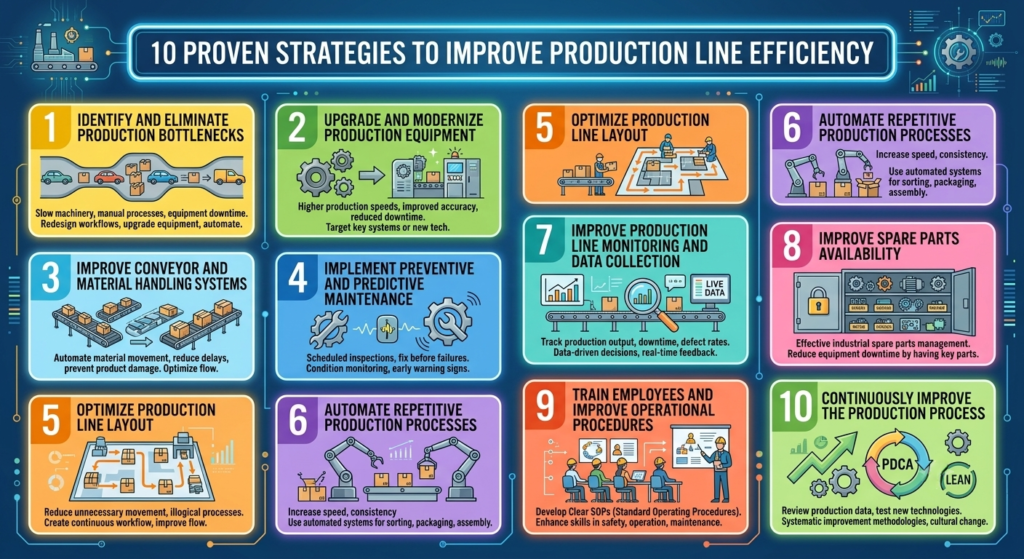
10 Proven Strategies to Improve Production Line Efficiency
1. Identify and Eliminate Production Bottlenecks
One of the first steps toward improving production line efficiency is identifying bottlenecks.
A bottleneck is any stage of the production process that limits the overall output of the entire line. Even if the rest of the production line is operating efficiently, a single slow process can reduce total production capacity.
Common causes of production bottlenecks include:
- Slow machinery
- Manual processes
- Insufficient labor
- Poor material flow
- Equipment downtime
- Long changeover times
- Inefficient production layouts
Manufacturers should analyze the entire production workflow to determine where delays occur.
For example, if products are being manufactured faster than they can be packaged, the packaging stage becomes a bottleneck. Similarly, if raw materials are not delivered to production stations on time, operators and machines may remain idle.
Once bottlenecks are identified, manufacturers can improve efficiency by:
- Upgrading equipment
- Increasing processing capacity
- Automating repetitive tasks
- Improving material handling
- Redesigning production workflows
Eliminating bottlenecks can have a significant impact on overall production output without requiring a complete factory redesign.
2. Upgrade and Modernize Production Equipment
Outdated machinery can have a major impact on production line efficiency.
Older equipment often requires more maintenance, consumes more energy, and operates at lower speeds than modern systems. It may also be difficult to integrate with modern automation and control technologies.
Upgrading critical equipment can provide several benefits, including:
- Higher production speeds
- Improved accuracy
- Reduced downtime
- Lower maintenance costs
- Better energy efficiency
- Improved product consistency
However, replacing every machine is not always necessary.
In many cases, manufacturers can improve existing equipment through targeted upgrades such as:
- New motors
- Improved control systems
- Modern sensors
- Variable frequency drives
- Automation components
- Improved conveyor systems
A professional assessment can help determine which equipment should be replaced, upgraded, or integrated with new technology.
3. Improve Conveyor and Material Handling Systems
Material handling plays a critical role in production line efficiency.
If raw materials, components, or finished products cannot move smoothly through the facility, production will slow down regardless of how efficient the machines are.
Modern conveyor systems help automate the movement of products and materials between different stages of production.
Depending on the application, manufacturers may use:
- Belt conveyors
- Roller conveyors
- Chain conveyors
- Modular conveyors
- Overhead conveyor systems
- Custom conveyor solutions
A well-designed conveyor system can:
- Reduce manual handling
- Improve material flow
- Reduce production delays
- Minimize product damage
- Improve workplace safety
- Increase production throughput
The conveyor system should be designed according to the product characteristics, factory layout, required production speed, and operating environment.
For manufacturers experiencing frequent material handling delays, upgrading or redesigning the conveyor system can be one of the most effective ways to improve production line efficiency.
4. Implement Preventive and Predictive Maintenance
Unexpected equipment failures are one of the biggest causes of production downtime.
When a critical machine stops working, the entire production line may be forced to stop until the problem is resolved.
A strong maintenance strategy can significantly reduce these interruptions.
Preventive Maintenance
Preventive maintenance involves performing scheduled inspections and maintenance activities before equipment fails.
Common activities include:
- Lubrication
- Component replacement
- Equipment inspections
- Belt and chain checks
- Motor inspections
- Electrical system testing
Predictive Maintenance
Predictive maintenance uses sensors and monitoring technologies to identify potential equipment failures before they occur.
Modern systems can monitor:
- Vibration
- Temperature
- Motor performance
- Energy consumption
- Equipment operating conditions
By identifying early warning signs, maintenance teams can schedule repairs at convenient times instead of dealing with unexpected breakdowns.
Combining preventive and predictive maintenance strategies can improve equipment reliability and reduce unplanned downtime.
5. Optimize Production Line Layout
The physical layout of a factory has a direct impact on production efficiency.
Poorly designed layouts can create unnecessary movement of:
- Raw materials
- Employees
- Components
- Finished products
- Packaging materials
This increases transportation time and creates unnecessary delays.
An optimized production line layout should aim to create a logical and continuous workflow.
Manufacturers should consider:
- Material flow
- Equipment positioning
- Worker movement
- Storage locations
- Maintenance access
- Safety requirements
- Future expansion
A well-planned layout reduces unnecessary movement and allows materials to move efficiently from one production stage to another.
In some cases, simply rearranging equipment and improving material flow can significantly increase production efficiency.
6. Automate Repetitive Production Processes
Automation is one of the most powerful tools available to modern manufacturers.
Many production tasks are repetitive, time-consuming, and prone to human error.
Examples include:
- Product sorting
- Packaging
- Labeling
- Material handling
- Quality inspection
- Assembly operations
Automating these processes can help manufacturers:
- Increase production speed
- Reduce human errors
- Improve consistency
- Lower labor costs
- Improve workplace safety
Automation does not necessarily mean creating a fully automated factory.
Manufacturers can start by automating the processes that have the greatest impact on productivity.
For example, integrating automated conveyors, sensors, and control systems into an existing production line can improve material flow without requiring a complete system replacement.
7. Improve Production Line Monitoring and Data Collection
You cannot improve what you cannot measure.
Modern factories generate large amounts of operational data that can help managers understand production performance.
Manufacturers should monitor key metrics such as:
- Production output
- Downtime
- Machine availability
- Cycle time
- Defect rates
- Energy consumption
- Maintenance frequency
Real-time monitoring systems can provide valuable information about production performance.
When a production line begins operating below expected performance levels, managers can quickly identify the problem and take corrective action.
Data-driven decision-making allows manufacturers to move from reactive problem-solving to proactive production management.
Over time, analyzing production data can reveal recurring problems and opportunities for improvement.
8. Improve Spare Parts Availability
A production line can only operate reliably when its critical components are available when needed.
A small mechanical component can sometimes cause a major production interruption if it fails and the replacement part is not available.
This is why effective industrial spare parts management is an important part of production efficiency.
Factories should identify critical spare parts and maintain appropriate inventory levels.
These may include:
- Bearings
- Belts
- Rollers
- Gears
- Shafts
- Chains
- Motors
- Electrical components
- Automation components
Manufacturers should also establish reliable relationships with trusted spare parts suppliers.
For obsolete or custom components, custom manufacturing can provide an effective alternative to long OEM lead times.
Having access to high-quality spare parts can significantly reduce equipment downtime and help maintenance teams restore production faster.
9. Train Employees and Improve Operational Procedures
Technology and equipment are only part of the production efficiency equation.
Employees play a critical role in maintaining efficient production operations.
Workers should receive proper training on:
- Equipment operation
- Safety procedures
- Maintenance requirements
- Quality standards
- Emergency procedures
- Production workflows
Well-trained employees are better equipped to identify problems before they become major failures.
Manufacturers should also develop clear standard operating procedures (SOPs) for critical production activities.
Standardized procedures help reduce variation, improve consistency, and ensure that tasks are performed correctly.
Continuous employee training can also encourage a culture of improvement where workers actively identify inefficiencies and suggest solutions.
10. Continuously Improve the Production Process
Production line optimization should not be treated as a one-time project.
Manufacturing environments change continuously due to:
- New products
- Increased demand
- New technologies
- Equipment aging
- Changing customer requirements
- Market competition
For this reason, manufacturers should continuously evaluate their production processes.
Continuous improvement can involve:
- Reviewing production data
- Identifying recurring problems
- Testing new technologies
- Improving maintenance strategies
- Upgrading equipment
- Optimizing workflows
Manufacturers can use established improvement methodologies such as Lean Manufacturing and Six Sigma to systematically identify waste and improve process performance.
The goal is to create a culture where efficiency improvements become an ongoing part of the organization.
How Conveyor Systems Can Improve Production Line Efficiency
Conveyor systems are an essential component of many modern manufacturing facilities.
By automating the movement of products and materials, conveyors reduce the need for manual transportation and create a more consistent production flow.
An efficient conveyor system can help manufacturers:
- Reduce material handling time
- Improve production speed
- Minimize product damage
- Reduce labor requirements
- Improve workplace safety
- Connect multiple production stages
However, choosing the right conveyor system is critical.
The system should be designed according to:
- Product type
- Product weight
- Production speed
- Available space
- Environmental conditions
- Required automation level
Custom-designed conveyor solutions can be particularly valuable for factories with complex layouts or specialized production requirements.
The Role of Industrial Automation in Production Efficiency
Industrial automation is transforming the way modern factories operate.
Automation technologies allow manufacturers to connect machines, sensors, conveyors, and control systems into a unified production environment.
Modern automation solutions can help with:
- Process control
- Material handling
- Product inspection
- Packaging
- Sorting
- Data collection
- Equipment monitoring
When properly implemented, automation can improve production efficiency while reducing human error and operational variability.
However, automation should be implemented strategically.
Manufacturers should first identify the processes that will provide the greatest return on investment before investing in new technologies.
How Industrial Spare Parts Support Production Continuity
Equipment reliability is directly connected to the availability of spare parts.
Even the most advanced production line can experience downtime if a critical component fails and no replacement is available.
Working with a reliable industrial spare parts manufacturer and supplier can help factories:
- Reduce equipment downtime
- Improve maintenance response times
- Maintain production continuity
- Extend equipment lifespan
- Reduce emergency procurement costs
Custom-manufactured spare parts can also provide solutions for older machinery or components that are no longer available from the original manufacturer.
This makes spare parts planning an essential part of any long-term production efficiency strategy.
How to Measure Production Line Efficiency
To determine whether efficiency improvements are working, manufacturers need to track relevant performance indicators.
Some of the most important KPIs include:
Overall Equipment Effectiveness (OEE)
OEE measures equipment performance based on availability, performance, and quality.
Production Throughput
This measures the total quantity of products produced within a specific period.
Downtime
Tracking downtime helps manufacturers identify the frequency and causes of production interruptions.
Cycle Time
Cycle time measures how long it takes to complete a production process or produce one unit.
Defect Rate
Monitoring defects helps identify quality issues that may reduce production efficiency.
Changeover Time
Reducing the time required to switch between products can increase overall production capacity.
By monitoring these KPIs, manufacturers can identify trends and measure the effectiveness of improvement initiatives.
When Should You Consider Upgrading Your Production Line?
Manufacturers should consider upgrading their production lines when they experience:
- Frequent equipment breakdowns
- Increasing production downtime
- Rising maintenance costs
- Low production capacity
- Excessive manual handling
- High energy consumption
- Inconsistent product quality
- Difficulty meeting customer demand
A production line upgrade does not always require replacing the entire system.
In many cases, targeted improvements such as conveyor upgrades, automation integration, equipment modernization, and spare parts optimization can deliver significant results.
How Atlas Industrial Solutions Can Help Improve Production Line Efficiency
Atlas Fo Industrial Solutions provides industrial solutions designed to help manufacturers improve production performance and optimize their manufacturing operations.
Depending on the needs of each facility, solutions may include:
- Conveyor system design and installation
- Production line development
- Industrial automation solutions
- Custom manufacturing of industrial spare parts
- Equipment upgrades
- Maintenance support
- Engineering and technical solutions
By combining engineering expertise, modern technologies, and customized industrial solutions, manufacturers can address production bottlenecks, improve material flow, reduce downtime, and create more reliable production environments.
The right solution depends on the specific challenges of each factory. A detailed assessment of the production line can help identify the areas with the greatest potential for improvement.
Conclusion
Improving production line efficiency is a continuous process that requires a combination of technology, maintenance, engineering, and effective operational management.
Manufacturers can achieve significant improvements by identifying bottlenecks, upgrading equipment, optimizing conveyor and material handling systems, implementing preventive and predictive maintenance, improving factory layouts, and adopting targeted automation solutions.
Reliable spare parts availability and well-trained employees are equally important for maintaining stable production operations.
The most successful factories are not necessarily those with the newest equipment. They are the ones that continuously evaluate their operations, identify inefficiencies, and invest strategically in the areas that have the greatest impact on productivity.
By adopting these 10 strategies and continuously monitoring production performance, modern factories can reduce downtime, increase output, improve product quality, and build a more efficient and competitive manufacturing operation.
For manufacturers looking to optimize their production lines, improve material handling, upgrade conveyor systems, or implement industrial solutions, working with an experienced industrial engineering partner can be an important step toward achieving long-term production efficiency and operational excellence.
Get in Touch Now
We are ready to help you anytime via WhatsApp or Email
Pingback: What Is Industrial Automation and How Does It Improve Manufacturing? - Atlas